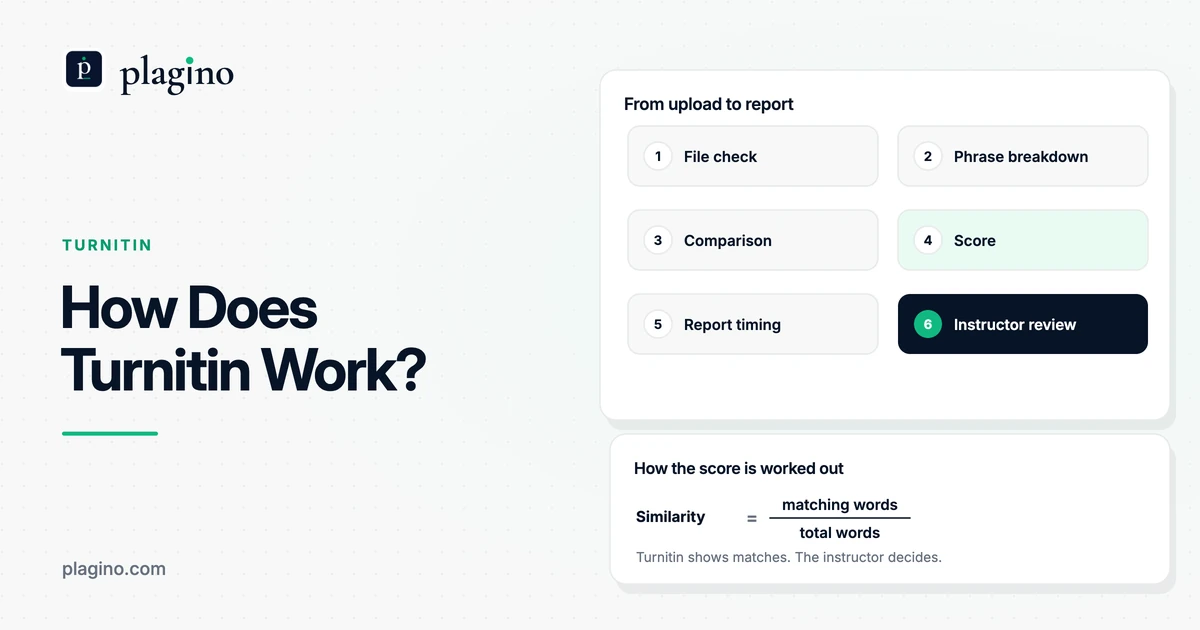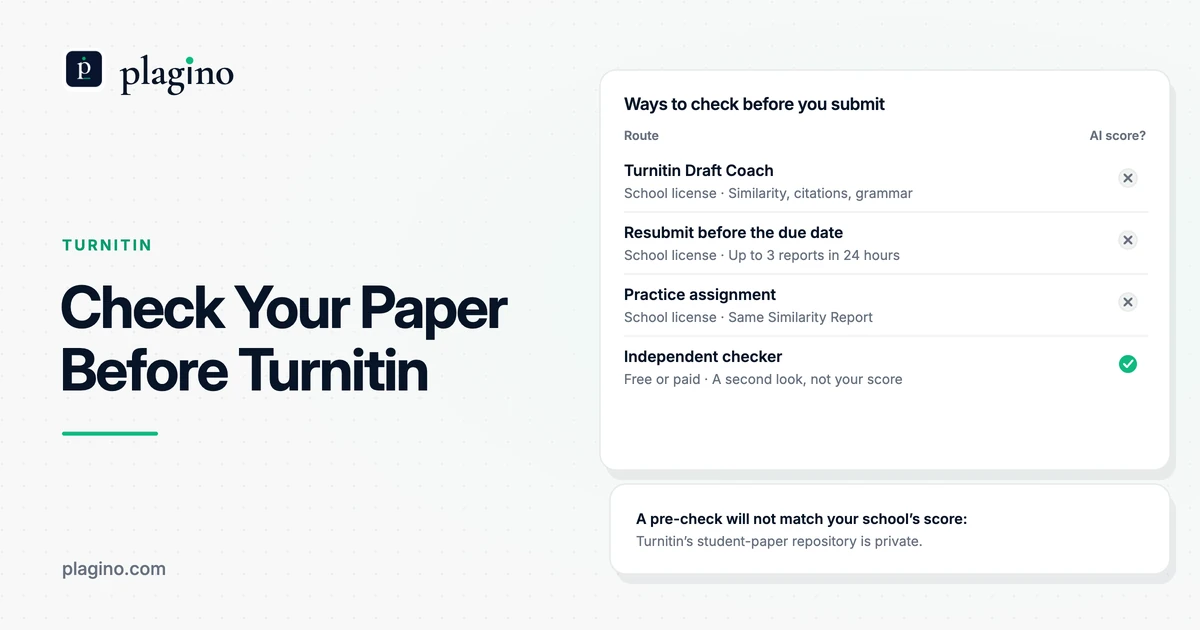
The short answer
The best alternative to Turnitin depends on the check you need. Turnitin sells only to schools, so students use Scribbr for a Turnitin-powered plagiarism check, and GPTZero, Copyleaks, Winston AI or Plagino for AI detection. No public tool can see your university's private paper database, so no alternative will match its score exactly.
Why can't students just use Turnitin?
Turnitin has no plan for individuals. It licenses its checker to schools, colleges and universities, so the only way a student sees a Turnitin report is through an assignment their institution has set up. Even Turnitin's own student tool, Draft Coach, only works when your institution's licence and Microsoft 365 administrators switch it on. Colleges differ in what they run, and some have switched AI detection off; our guide covers what AI detector colleges use.
Being locked out matters because Turnitin is everywhere. As of 2025, Turnitin licensed its service to more than 16,000 universities and high schools, covering over 71 million students. The company, founded in 1998 in Oakland, California, has been owned by Advance Publications since a $1.75 billion acquisition in 2019. If you only want a free AI check before you submit, our guide to a Turnitin AI checker alternative covers that narrower question.
What Turnitin checks your paper against
Turnitin compares a submission with three kinds of source: public web pages, licensed academic publications, and its own repository of past student papers. That last database held 1.9 billion submissions as of June 2025, and it is private.
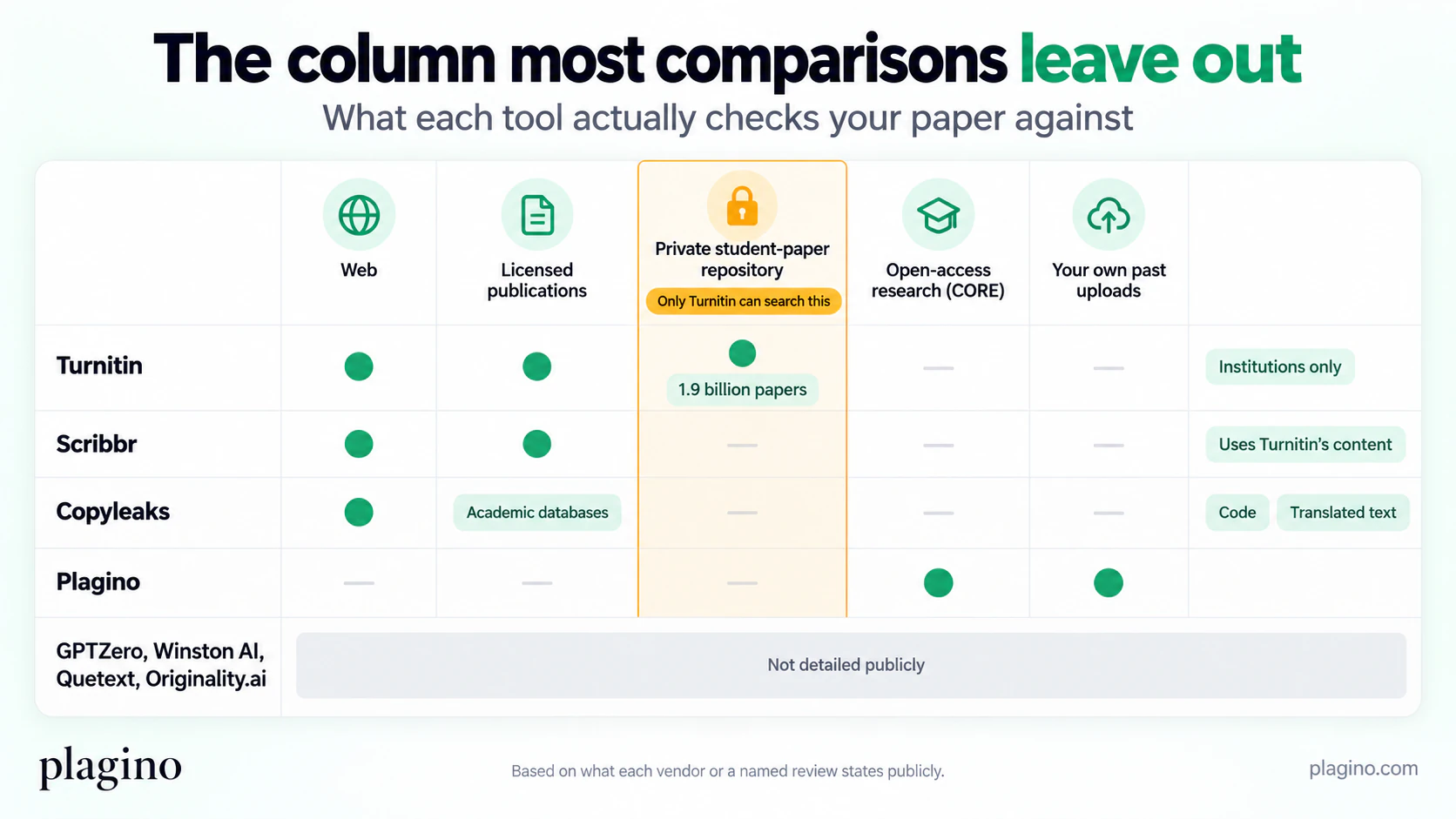
The private repository is what separates Turnitin from every public checker. An alternative can search the same web and many of the same journals, but it cannot see essays other students handed in at other schools. Keep that in mind whenever a vendor promises "Turnitin-level" results.
Does Turnitin keep a copy of your paper?
By default, yes. Turnitin adds submitted papers to its repository so future submissions can be checked against them, and a 2009 US court case, A.V. v. iParadigms, upheld that practice as fair use. Instructors and administrators can change the setting so a paper is checked without being stored, but the student usually cannot.
This has one practical consequence. If you submit a draft to a Turnitin assignment that stores papers, your final version can match your own draft and show a high similarity score. Ask your instructor whether a draft submission is stored before you use it as a test run. Our guide to what green, blue and the other Turnitin colors mean explains how that kind of self-match shows up in the score.
What should a good Turnitin alternative do?
A useful alternative tells you which passages look copied or machine-written, shows you why, and treats your document with care. Most comparison lists rank tools on accuracy claims alone, but the right choice turns on three questions that vendors answer very differently.
Plagiarism checking and AI detection are different checks
A plagiarism checker looks for text that matches an existing source. An AI detector looks for writing that is statistically predictable in the way language models are, whether or not it matches anything. Turnitin now runs both, and a paper can pass one and fail the other.
Decide which risk worries you before you pick a tool. A quote you forgot to cite is a plagiarism problem. A paragraph you tidied up with a chatbot is an AI-detection problem. Some alternatives only do one of these jobs.
Privacy: where does your document go?
Check three things in a checker's privacy policy: whether it adds your paper to a shared database, whether it republishes content, and whether you can delete your file. Scribbr, for example, says it does not add documents to any public or shared database and removes them after one year.
Some services go the other way. Quetext's own comparison notes that the terms of Viper, the checker on ScanMyEssay, allow submitted content to be republished on affiliated study sites. A paper that appears online before you submit it can later be matched as plagiarism against yourself.
Report detail, file types and price
A single percentage is not much use when you are revising. Look for sentence-level highlighting, a list of matched sources, and a report you can download and keep. Check the accepted file types too: some tools take PDF and Google Docs, while others only accept Word files or pasted text.
Pricing models differ more than the headline numbers suggest. Scribbr charges per document, Copyscape charges per search, and most AI detectors sell monthly plans with word or credit limits. Work out how many papers you will actually check this term before you subscribe.
Which Turnitin alternatives are worth using in 2026?
These eight tools cover the realistic options for a student or instructor without Turnitin access. Prices are the vendors' published rates at the time of writing (September 2026); they change often, so confirm them on the vendor's site.
Scribbr: the closest match to Turnitin's plagiarism check
Scribbr runs its plagiarism checker in partnership with Turnitin and compares your document against Turnitin's web and publication content. It charges per document rather than per month: $19.95 up to 7,499 words, $29.95 up to 49,999 words, and $39.95 above that, with a limited free version.
Scribbr is clear about its limit. Its FAQ says universities may check work against private student-paper databases that Scribbr cannot access, and that no other public checker can access them either. It is the best choice for one important plagiarism check, not for weekly AI screening. If you are weighing its AI detector instead, see Plagino vs Scribbr.
GPTZero: AI detection built for classrooms
GPTZero started as an AI detector and has added plagiarism checking, writing reports and classroom tools. It highlights likely AI-written sentences, integrates with Canvas, Google Classroom, Moodle and Blackboard, and offers a free plan alongside paid plans from $12.99 a month billed annually.
It is a strong fit for teachers who want AI screening inside their learning management system (LMS). Winston AI's comparison reports that it struggles with paraphrased and technical writing, so treat a borderline score as a reason to reread, not a verdict. Our Plagino vs GPTZero comparison sets its accuracy claims next to independent test results.
Copyleaks: widest language and LMS coverage
Copyleaks combines AI detection and plagiarism checking with features most rivals lack: translated-plagiarism detection, source-code checking and support for around 100 languages. It connects to more learning management systems than most alternatives, including Canvas, Moodle, Blackboard, Brightspace and Sakai.
Personal plans start at $16.99 a month, or less on annual billing, and institutions get custom pricing. GPTZero's own testing reported that Copyleaks misclassified about 1 in 20 human-written samples as AI, a figure worth knowing if you write in a second language.
Winston AI: AI detection with readable reports
Winston AI pairs AI detection with a plagiarism checker and presents results as an AI prediction map, with sentence-level highlights and a readability score. It reads PDFs and documents, can check images, and runs on a credit system where one word of AI detection costs one credit.
Plans start at $12 a month billed annually, and a 14-day free trial includes 2,000 credits. It suits students and educators who want an explainable report rather than a bare number, though plagiarism checks use credits twice as fast as AI checks.
Quetext: a low-cost plagiarism checker
Quetext's DeepSearch checker uses contextual matching to catch reworded passages, and colour-codes matches by how closely they follow the source. The free plan covers up to 1,000 words of plagiarism checking and 1,000 words of AI detection.
Paid plans start at about $8.25 a month and raise the limit to 100,000 words a month with bulk uploads. It is a sensible pick for a student who mainly worries about citations and paraphrasing on a tight budget.
Grammarly: plagiarism checking inside a writing assistant
Grammarly's paid plan adds a plagiarism checker and an AI detector to its grammar and style suggestions, and it works inside Google Docs and Microsoft Word. Pro costs $12 a month billed annually or $30 month to month.
It is convenient if you already pay for Grammarly, but GPTZero's comparison rates its AI detection as inconsistent, with accuracy anywhere from 54% to 97% across tests. Use it for surface editing and a first originality pass, not as your only check on a high-stakes paper.
Originality.ai: strong detection, built for publishers
Originality.ai combines AI detection, plagiarism checking and fact-checking, and is aimed at editors and content teams rather than students. Plans start at $14.95 a month billed annually, with a pay-as-you-go credit option for occasional use.
GPTZero's comparison rates its detection above average, but Winston AI's review notes that its reports explain less than education-focused tools and can over-flag writing by non-native English speakers. Students are better served elsewhere unless they already use it for freelance work.
Plagino: sentence-level AI and source checks on a Word file
Plagino is our tool, so weigh this entry accordingly. You upload a .docx file of up to 10 MB, and it returns sentence-level AI highlights, a plagiarism score with matched sources, and a PDF report. Source matching searches CORE, an open-access research index, plus your own earlier uploads. In our published benchmark it wrongly flagged 0.8% of human-written documents, against 1.4% for Turnitin, while catching slightly fewer AI-written ones. Our guide to the best AI detectors shows all seven tools side by side.
The free plan includes 3 scans a month with no card required, and Pro costs $19 a month for 20 scans a day. Uploads are never used to train AI models, and you can delete any scan from your dashboard. It is not your school's checker and will not reproduce its score. It shows you what an automated AI detector tends to flag before someone else runs one.
How do Turnitin alternatives compare side by side?
The column most comparisons leave out is the one that decides how close a tool can get to Turnitin: what it actually checks your paper against.
| Tool | Plagiarism check | AI detection | Checks against | Individual access | Starting price |
|---|---|---|---|---|---|
| Turnitin | Yes | Yes | Web, licensed publications, private repository of 1.9B student papers | No, institutions only | Quote only |
| Scribbr | Yes | Yes | Turnitin's web and publication content; no student-paper repository | Yes | $19.95 per document |
| GPTZero | Yes | Yes | Not detailed publicly | Yes | Free; $12.99/mo annual |
| Copyleaks | Yes | Yes | Web, academic databases, code, translated text | Yes | $16.99/mo |
| Winston AI | Yes | Yes | Not detailed publicly | Yes | 14-day trial; $12/mo annual |
| Quetext | Yes | Yes | Not detailed publicly; contextual matching | Yes | Free (1,000 words); ~$8.25/mo |
| Grammarly | Yes (paid) | Yes | Web pages and academic papers | Yes | Free grammar; $12/mo annual |
| Originality.ai | Yes | Yes | Not detailed publicly | Yes | $14.95/mo annual |
| Plagino | Yes | Yes | CORE open-access research index and your own past uploads | Yes | Free (3 scans/mo); $19/mo |
Which AI detector is closest to Turnitin?
In Plagino's March 2026 benchmark, Plagino and Originality.ai came closest to Turnitin on how much AI writing they caught, and Plagino and Academi.cx came closest on false flags. No tool matched Turnitin on both rates, and no tool can reproduce the score your school sees. Plagino ran the test and is one of the seven tools in it, so read the method on the benchmark page before you rely on our ranking.
People hunting for a stand-in report the same problem. One Reddit poster who tried QuillBot, Grammarly and GPTZero while writing a thesis said the results were not consistent, from 0 to 80-100% AI. Another said Turnitin flagged assignments at about 60% while every free detector they tried said 0-5%. Those are anecdotes, not tests, but they match what the table below shows: similar tools can still disagree.
What makes an AI detector like Turnitin?
Turnitin's AI checker is built into its similarity workflow and connects to your learning management system, so instructors see one report with both checks. A detector that feels like Turnitin therefore does three things: it highlights individual sentences, it sits alongside a plagiarism check, and it works inside the tools teachers already use. GPTZero and Copyleaks offer LMS connections; Plagino returns highlights and source matches in one PDF report.
Resemblance in features does not make scores match. Turnitin hides the AI percentage below 20% and shows an asterisk instead, while other tools show every score. Models, training data and thresholds all differ, which is why a paper can read 0-5% in one tool and 60% in another, as the second poster above reported. Use a stand-in to find sentences worth rewording, and treat the number as secondary.
| Detector | AI documents caught | Gap vs Turnitin (points) | Human documents wrongly flagged | Gap vs Turnitin (points) | Detection interval overlaps Turnitin's? |
|---|---|---|---|---|---|
| Turnitin (reference) | 98.2% | reference | 1.4% | reference | reference |
| Plagino (this site) | 97.4% | -0.8 | 0.8% | -0.6 | Yes |
| Originality.ai | 95.6% | -2.6 | 4.1% | +2.7 | Yes |
| Copyleaks | 91.3% | -6.9 | 2.2% | +0.8 | No |
| GPTZero | 88.9% | -9.3 | 5.7% | +4.3 | No |
| Academi.cx | 86.4% | -11.8 | 1.9% | +0.5 | No |
| TurnDetect | 79.5% | -18.7 | 6.3% | +4.9 | No |
Plagino caught 97.4% of AI-written documents, 0.8 points below Turnitin, with 0.8% false flags against Turnitin's 1.4%. Originality.ai caught 95.6%, but it wrongly flagged 4.1% of human documents. Academi.cx sat closest to Turnitin on false flags (1.9%) yet caught 11.8 points fewer AI documents. GPTZero trailed by 9.3 points on detection.
Plagino has not benchmarked ZeroGPT, QuillBot, Pangram, Grammarly, Scribbr's AI detector, Winston AI or Sapling, so this page makes no claim about how close any of them is to Turnitin. Vendor claims of "Turnitin-level" accuracy are claims, not measurements. Our best AI detectors guide shows the full benchmark with confidence intervals.
Turnitin vs GPTZero: how do they compare?
GPTZero is a separate product from Turnitin, and it was not close to Turnitin in Plagino's benchmark. Turnitin caught 98.2% of AI-written documents and wrongly flagged 1.4% of human ones. GPTZero caught 88.9% and wrongly flagged 5.7%, about four times Turnitin's false flag rate. GPTZero's gap to Turnitin on detection was 9.3 points.
The practical difference is access. A student can open a GPTZero account today, while Turnitin's AI report is only available through an institution. For a full head-to-head with pricing and limits, read our Plagino vs GPTZero comparison, and for what Turnitin's own detector does, see how Turnitin's AI detection works.
| Feature | Turnitin | GPTZero |
|---|---|---|
| Who can buy it | Institutions only | Individuals and institutions |
| Checks offered | Similarity and AI writing | AI detection, plus plagiarism checking and writing reports |
| AI documents caught (March 2026 benchmark) | 98.2% | 88.9% |
| Human documents wrongly flagged (March 2026 benchmark) | 1.4% | 5.7% |
| Starting price | Quote only | Free plan; paid from $12.99/mo billed annually |
Is there a free alternative to Turnitin?
Yes, but every free option trades something away: word limits, fewer sources, adverts, or looser privacy terms. For one short assignment, a free tier is often enough. For a dissertation, a paid single check is usually the better buy.
The workable free options in 2026 are Quetext (1,000 words of plagiarism and AI checking), GPTZero's free plan, Plagino's 3 free scans a month, and Scribbr's limited free check. DupliChecker offers free checks of up to 1,000 words but shows ads, and Plagiarism Checker X has a free Windows desktop version that, according to its maker, checks documents without uploading the file.
Read the terms before you paste a paper into a free tool you have never heard of. A checker that stores or republishes your text can create the very match you were trying to avoid.
Be careful with sites that have "Turnitin" in their name and promise a free score. Turnitin's help center says Turnitin access is only available through an academic institution and that individual accounts cannot be bought. A free paste-in box under that name is therefore another company's tool, and its score is not a Turnitin score.
iThenticate vs Turnitin: what is the difference?
iThenticate and Turnitin come from the same company and, according to Turnitin's help center, use the same database to find overlapping text, but they serve different users. Turnitin is for instructors and students and is sold only to institutions. iThenticate is for researchers, publishers and authors, and individuals can buy it.
That makes iThenticate the one official route to Turnitin-company similarity checking that a researcher or graduate student can buy alone. As of October 2026, ithenticate.com lists individual credits at $125 for one manuscript of up to 25,000 words and $300 for up to three manuscripts or one up to 75,000 words, valid for 12 months with five free revisions. The same page says AI writing detection is not available on those individual credits.
| Feature | Turnitin | iThenticate |
|---|---|---|
| Main users | Instructors and students | Researchers, publishers and authors |
| Typical use | Grading, feedback and integrity checks in the classroom | Originality checks on scholarly papers and manuscripts |
| Account type | Institutional only; no individual accounts | Individual and organizational accounts |
| Stored in a repository? | Usually saved to a global repository, at the instructor's choice | Individual documents are never saved; organizations can buy a private repository |
| AI writing detection | Yes, through an institution | Not included in individual credits; Turnitin's product page lists AI detection for the product |
Both products share a database, but their documents are kept apart. Turnitin's help center says documents uploaded to iThenticate are generally never compared against the Turnitin repository, and the reverse. So an iThenticate report will not show matches to other students' papers held in Turnitin's repository, and it will not preview your school's score. See the product page for how organizations use it.
Will a Turnitin alternative give you the same score?
No. Each checker searches different sources and uses a different AI model, so two tools can score the same paper very differently. A similarity or AI percentage from an alternative is a guide to which passages to reread, not a forecast of your Turnitin report.
Why plagiarism scores differ between checkers
Similarity scores depend on the source pool. Turnitin can match your paper to an essay a student at another university submitted last year; a public checker cannot. Settings matter too: your instructor may exclude quotes, bibliographies or small matches, which changes the percentage.
So a clean result elsewhere is reassuring but not a guarantee. The most useful thing an alternative does is show you uncited quotes and close paraphrases you can fix, whatever score they produce.
How reliable is Turnitin's own AI detector?
Turnitin says its document-level false positive rate is below 1% when a paper contains 20% or more AI writing, and that the sentence-level rate is around 4%. Below 20%, its report shows an asterisk instead of a number, because Turnitin found false positives are more common at low scores.
Not every university accepted that trade-off. Vanderbilt University disabled Turnitin's AI detector from 16 August 2023, estimating that a 1% false positive rate across its 75,000 yearly submissions could wrongly flag about 750 papers. A 2023 Stanford study found that several AI detectors misclassified more than half of TOEFL essays by non-native English writers as AI-generated.
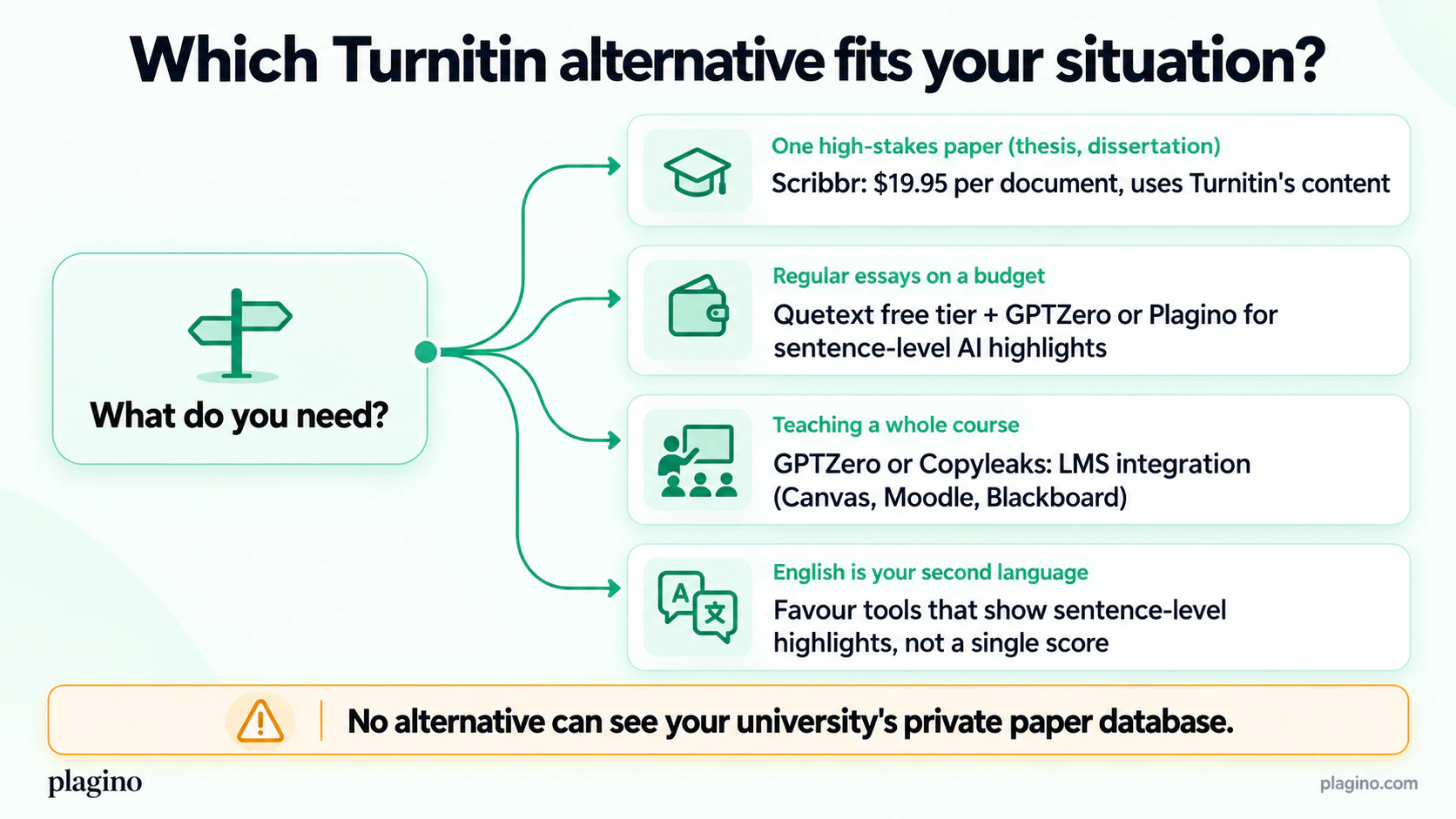
Which Turnitin alternative fits your situation?
Match the tool to the job rather than chasing the highest advertised accuracy. These pairings follow from what each tool checks and how it charges.
Students checking a paper before submission
Use Scribbr for one high-stakes plagiarism check, such as a thesis or dissertation, because it draws on Turnitin's content. For regular essays, pair a free plagiarism tier such as Quetext with an AI detector that highlights sentences, such as GPTZero or Plagino, so you know exactly which lines to revise.
If English is your second language, favour tools that show sentence-level evidence over a single score. Detector bias against non-native writing is documented, and highlighted sentences give you something concrete to discuss if a flag is ever raised.
Researchers and graduate students preparing a manuscript
For a journal submission, thesis or dissertation, an individual iThenticate account is the official route to a Turnitin-company similarity check, priced per manuscript. If a cheaper first pass is enough, use Scribbr's Turnitin-powered checker or a free tier, and run a sentence-level AI check separately.
Keep the scope clear: iThenticate's individual credits do not include AI detection, so pair them with an AI detector if your target journal or university asks for one.
Teachers and institutions
Instructors who need a Turnitin replacement across a course should shortlist tools with LMS integration: GPTZero and Copyleaks both connect to Canvas, Moodle and Blackboard. Check each vendor's data-processing terms against FERPA in the US or GDPR in the UK and EU before rolling it out.
Whatever you choose, write down how scores will be used. Vanderbilt's decision is a reminder that an AI score on its own is weak evidence, and a clear policy protects both students and staff.
How to check your paper before you submit it
A short pre-submission routine catches most problems that a Turnitin report would flag, without relying on any one tool's score.
- 1
Finish your citations first. Add every in-text citation and your reference list before you run any check, so the report flags real gaps rather than work in progress.
- 2
Run a plagiarism check. Use a checker with a published source list, such as Scribbr for a major paper or Quetext for a short one, and note every match it lists.
- 3
Fix matches at the source. Quote and cite any copied wording, and rewrite close paraphrases in your own structure rather than swapping synonyms.
- 4
Run an AI detection check. Use a detector that highlights individual sentences, such as GPTZero, Winston AI or Plagino, so you can see which lines drive the score.
- 5
Reread the flagged sentences. Keep any sentence that says what you meant in words you would use, and revise filler you could not defend if asked about it.
- 6
Keep your evidence. Save the reports, your drafts and your version history, which help you show your process if a flag is ever raised.
Frequently asked questions
What is the best alternative to Turnitin?
There is no single best alternative, because Turnitin runs two checks and its private paper database is not available to anyone else. Scribbr is the closest match for plagiarism, since it uses Turnitin's content. For AI detection, GPTZero, Copyleaks, Winston AI and Plagino all highlight individual sentences.
Can individuals use Turnitin?
No. Turnitin sells only to institutions, so students and freelance writers cannot buy their own account. The nearest individual routes are indirect: iThenticate credits for researchers and graduate students, or Scribbr's Turnitin-powered plagiarism checker.
Can students use Turnitin without a school account?
No. Turnitin reports are only available through an institution's licence, usually inside an assignment in your learning management system. Some schools also enable Turnitin Draft Coach in Microsoft Word, but only if the institution has switched it on.
Is Scribbr the same as Turnitin?
No, but they are linked. Scribbr's plagiarism checker is powered by Turnitin and compares your document with Turnitin's web and publication content. It cannot access the private student-paper databases that universities check against, so small differences in scores are normal.
Is there a Turnitin alternative that doesn't store your paper?
Yes. Scribbr says it never adds documents to a public or shared database and removes them after one year, and Plagiarism Checker X runs as a desktop app that, according to its maker, does not upload the file. Plagino keeps files only in your own account, where you can delete them at any time.
Which Turnitin alternative detects AI?
Most do now. GPTZero, Copyleaks, Winston AI, Originality.ai, Quetext, Grammarly and Plagino all include an AI detector. They differ most in how they report results: tools that highlight individual sentences are more useful for revising than a single percentage.
Can Turnitin detect paraphrased ChatGPT reliably?
Not reliably. Lightly edited or paraphrased AI text often scores lower than untouched output, which is one reason every AI detector, including Turnitin's, produces false negatives as well as false positives. Detection is a probability estimate, not proof of how a text was written.
Why does Turnitin show an asterisk instead of an AI percentage?
An asterisk means Turnitin detected less than 20% likely AI writing. Turnitin hides the exact figure and highlighting below that threshold because false positives are more common at low scores.
What do universities use instead of Turnitin?
Some institutions use Copyleaks or GPTZero instead, often through LMS integrations such as Canvas and Moodle, and others run them alongside Turnitin. Some universities, including Vanderbilt in 2023, switched off Turnitin's AI detector while keeping its plagiarism checker.
Is using a Turnitin alternative allowed?
Generally yes. Checking your own work before submission is normal practice, and nothing in how Turnitin works prevents it. Check your course's academic integrity policy for rules on AI tools, and avoid checkers whose terms let them republish your text.
Why do different AI detectors give different scores for the same essay?
Each detector uses its own model, training data and threshold, so the same text can land on different sides of the line. Formal, formulaic and second-language writing is especially likely to vary. Compare which sentences each tool highlights rather than the headline numbers.
How much do Turnitin alternatives cost?
Most cost between about $8 and $20 a month, and several have free tiers. Scribbr charges per document instead, from $19.95 for up to 7,499 words. Plagino is free for 3 scans a month, and Pro is $19 a month.
Which AI detector is closest to Turnitin?
In Plagino's March 2026 benchmark, Plagino and Originality.ai were closest to Turnitin on detection, and Plagino and Academi.cx were closest on false flags. Plagino caught 97.4% of AI documents against Turnitin's 98.2%. Plagino ran the test, and no detector reproduces your school's Turnitin score.
Is there a free AI detector like Turnitin?
Several free tools give a Turnitin-style AI check, but none can match your school's score. GPTZero has a free plan, Plagino includes 3 free scans a month, and Quetext offers 1,000 words of free AI detection. Of these, only GPTZero and Plagino were in Plagino's benchmark; Plagino has not benchmarked Quetext.
Is GPTZero as good as Turnitin?
Not in Plagino's March 2026 benchmark. Turnitin caught 98.2% of AI-written documents and wrongly flagged 1.4% of human ones, against 88.9% and 5.7% for GPTZero. The two are separate products, so a GPTZero score will not predict your Turnitin report.
What is the difference between iThenticate and Turnitin?
iThenticate is for researchers, publishers and authors, and Turnitin is for instructors and students. Turnitin says both use the same database to find overlapping text. Turnitin is sold only to institutions, while individuals can buy iThenticate credits.
Can students buy iThenticate?
Yes, individuals can. ithenticate.com says its credits are for researchers, scholars and graduate students preparing manuscripts, theses or dissertations. As of October 2026 they start at $125 for one manuscript of up to 25,000 words, and AI writing detection is not included.
Does Plagino give the same AI score as Turnitin?
No. Plagino is an independent tool, and its percentages are not Turnitin scores. In the March 2026 benchmark the two had similar document-level rates (97.4% and 98.2% caught), but those are rates across 1,000 documents, not agreement on any single paper.