The short answer
Yes, but only where a school licenses Turnitin Originality and switches the AI writing indicator on. As of October 2026 it targets text from ChatGPT, Claude, Gemini and other large language models, including AI text run through paraphrasers. Instructors see the score, students do not, and it is a signal, not proof.
Does Turnitin check for AI on every paper?
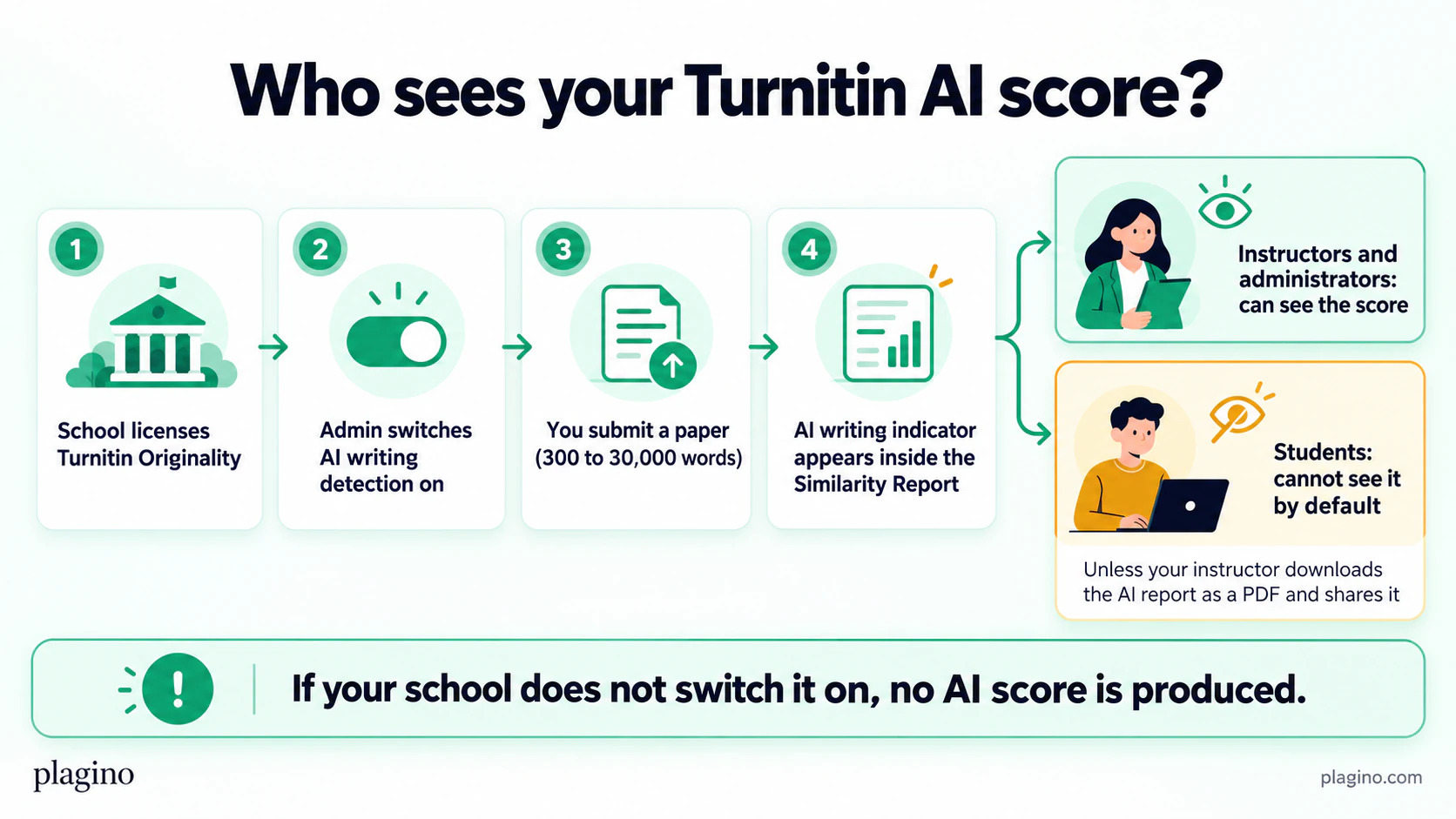
No. Turnitin checks for AI only where the institution has paid for it and left it switched on. According to Turnitin's AI writing FAQ, AI writing detection is available only to customers that license Turnitin Originality. Schools on Turnitin Similarity or Feedback Studio alone have to speak to their account manager to get it.
Administrators can also turn it off. The same FAQ says admins can enable or disable the AI writing feature from their settings page, and that Turnitin will not process a submission for AI writing if the institution does not use the feature. So two students submitting to Turnitin at different universities may get very different treatment: one paper is scored for AI, the other is not.
How does Turnitin detect AI? The method in Turnitin's words
Turnitin splits a submission into overlapping segments of sentences. Each segment gets a score between 0 and 1 for how likely it is to be AI-generated, each sentence inherits the scores of the segments it sits in, and those sentence scores are combined into one document percentage. The FAQ describes the current model as a transformer-based deep learning system trained on Turnitin's own corpus of academic writing. Its plain-language idea is that language models tend to pick the next word in a consistent, highly probable way, while human writing is more inconsistent and idiosyncratic.
Turnitin says the model is not programmed to measure single signals such as "perplexity" or "burstiness". It learns patterns from training data instead, which also means, in Turnitin's words, that individual predictions "may not always be explainable in simple feature-by-feature terms". The same FAQ says that in July 2026 Turnitin merged a multi-model ensemble into a single model and that the false positive rate stays under 1%.
Can Turnitin detect ChatGPT, Claude and Gemini?
Yes, for the models Turnitin lists, in English, where AI detection is switched on. As of October 2026, Turnitin's AI writing FAQ says its English model can detect content from GPT-4o and the GPT-5 family up to GPT-5.4, Gemini 1.0 Pro through Gemini 3.1 Pro preview, Claude 3 Haiku through Claude Sonnet 4.6 and Opus 4.5, Llama 3.3 and 4 Maverick, Mistral Large 3, DeepSeek v3.2, Nova 2 Lite and Grok 4.1, plus tools built on those models.
That list is Turnitin's own claim, not independent proof, and a model released after it is not promised: the FAQ says only that Turnitin will "continue to expand" coverage. In Plagino's March 2026 benchmark the AI-written half of the corpus came from GPT-4o, Claude and Gemini, some lightly edited by a person, and Turnitin flagged 98.2% of those 500 documents. Some third-party explainers are out of date: one dated March 2026 still names only GPT-3, GPT-3.5 and GPT-4 as detectable, with GPT-4o and LLaMA as future plans. For a ChatGPT-specific view, including edited and paraphrased text, see our guide on whether Turnitin can detect ChatGPT.
Can students see their Turnitin AI score?
Not by default. Turnitin's FAQ states that only instructors and administrators can see the AI writing indicator, and that the indicator and report "are not visible to students". An instructor can download the AI report as a PDF and share it with you, but that is their choice.
The AI score is also kept apart from the similarity score. The two are calculated independently and do not influence each other, and Turnitin says there is no AI score shown directly in the learning management system (LMS) interface. Instructors have to open the Similarity Report and select the AI Writing tab to see it.
If your instructor raises an AI concern, you are entitled to ask to see the report they are relying on. Our guide on what to do if you are falsely accused of using AI covers how to ask for it and what evidence of your writing process helps.
What do the Turnitin AI percentage and asterisk mean?
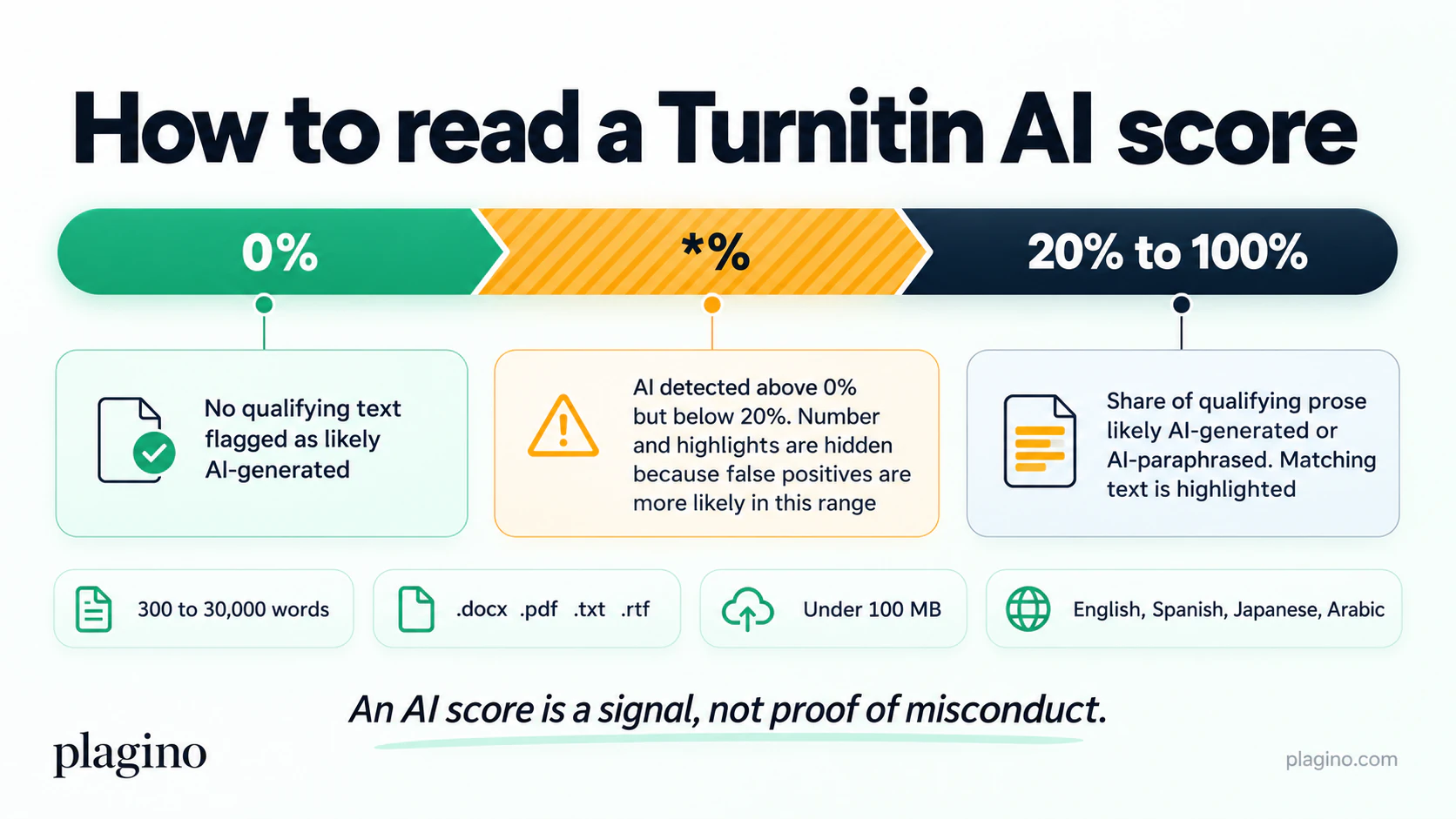
The percentage is the share of qualifying text, meaning prose sentences in long-form writing, that the model thinks was likely generated by AI or generated and then altered by a paraphraser or bypasser tool. It is not a percentage of the whole file. If your document has tables, lists or code, those parts are left out of the calculation, so the highlights and the number may not appear to line up.
Since a July 2024 update, scores between 1% and 19% are not shown. Turnitin's report guide says its testing "found that there is a higher incidence of false positives when the percentage is between 0 and 19", so the indicator shows an asterisk (*%) and no highlights instead. Reports generated before 8 July 2024 may still show a number below 20%.
| What you see | What it means |
|---|---|
| 0% | No qualifying text was identified as likely AI-generated or AI-altered. |
| *% (asterisk) | AI was detected above 0% but below 20%. No percentage or highlights are shown because false positives are more likely in this range. |
| 20% to 100% | That share of the qualifying prose was identified as likely AI-generated, or AI-generated and then paraphrased or bypassed. Matching text is highlighted. |
| Gray, no percentage (- -) | The file could not be processed for AI: it predates the feature or does not meet the file requirements. |
| Error (!) | Processing failed. Turnitin suggests resubmitting and contacting support if it persists. |
What can Turnitin's AI detector not check?
A paper only gets an AI score if it meets Turnitin's file requirements for an AI Writing Report. Anything outside these limits produces the gray "no percentage" state rather than a score.
| Requirement | Turnitin's limit |
|---|---|
| Minimum length | 300 words of prose in a long-form writing format |
| Maximum length | 30,000 words |
| File size | Less than 100 MB |
| File types | .docx, .pdf, .txt, .rtf |
| Languages | English, Spanish, Japanese, Arabic |
| Paraphraser and bypasser detection | English submissions only |
Turnitin is also open about the kinds of writing it does not score reliably. Its guide says the model does not reliably detect AI in poetry, scripts or code, and does not detect it in short-form or unconventional writing such as bullet points, tables or annotated bibliographies. Since August 2023, bibliographies are excluded from AI processing altogether.
Short papers carry an extra caveat. The FAQ explains that with only a few hundred words the prediction is mostly "all or nothing", because the model is scoring a single segment. A short piece that mixes your writing with AI text could therefore be flagged as entirely AI-generated.
Does Turnitin detect copy and paste?
Yes, but through the Similarity Report, not the AI indicator. According to Turnitin's guide to the similarity score, Turnitin compares each submission with billions of web pages, a repository of papers students have submitted before, and thousands of periodicals, journals and publications, then highlights text that matches. Quoted and referenced text also shows as a match, so the score is a prompt to review, not a verdict. Turnitin's own example compares a student who pasted in a chunk of text (20%) with a student who quoted and referenced several sources correctly (22%).
The AI indicator is a separate check. Turnitin says the two scores are independent and do not influence each other, and its AI report guide describes scoring prose sentences, not tracking how the text got into the file. Our guide to the Turnitin similarity score covers the matching side, and our explainer on what green means on Turnitin covers the color bands.
Does Turnitin show when text was pasted into a document?
Only in Turnitin Clarity. Turnitin describes Clarity as a paid add-on to Feedback Studio that works alongside Originality and lets educators see pasted text, writing time, construction time and draft history. Its student FAQ says the writing space records clipboard paste events and copy and cut events.
When Clarity and Originality are both licensed and AI detection is on, the Writing Report adds a pasted-text card with AI results. Turnitin's Clarity AI guide says the card appears when the model predicts that a pasted block of more than 300 words was likely written or altered by AI. That paste history comes from Clarity's own writing space, so it only exists for assignments an instructor sets up there.
Can Turnitin detect paraphrased or humanized AI text?
Turnitin says it can, in English. The AI writing model release notes show three steps: detection of AI text run through word spinners in December 2023, a separate breakdown for AI text that was then AI-paraphrased (QuillBot is Turnitin's example) in July 2024, and detection of AI bypasser tools, also called humanizers, in August 2025.
Turnitin will not say which paraphrasers or bypassers it was trained on, on the grounds that a list would make evasion easier. Its Spanish and Japanese detectors do not include paraphraser or bypasser detection at all. The release notes also say updates do not rewrite old reports: a paper only gets the newer model's score if it is resubmitted.
What about Grammarly?
Turnitin's FAQ says its tests on human-written documents found that, in most cases, spelling, grammar and punctuation changes made by Grammarly and similar tools were not flagged as AI. Text produced by Grammarly's generative features, such as drafting, paraphrasing and summarizing, is a different matter: Turnitin says that content will likely be flagged.
| Date | What changed |
|---|---|
| December 2023 | Likely AI text that was paraphrased with an AI word spinner is detected. |
| July 2024 | The report splits into AI-generated only and AI-generated then AI-paraphrased. Scores of 1% to 19% show as an asterisk. The word limit rises to 30,000. |
| August 2025 | AI bypasser tools are detected, and that share is counted in the AI-generated only category. |
| October 2025 | Model update to improve recall while keeping false positives low. |
| February 2026 | A second recall update, again with no visible change to the report. |
| May 2026 | Update to the Spanish-language AI writing model. |
| July 2026 | A multi-model ensemble is merged into a single model (stated in Turnitin's AI writing FAQ, not in the release notes page). |
What does Turnitin's AI detector catch and miss?
The table below pulls the rules from Turnitin's documentation into one view. It restates what Turnitin says, as of October 2026. Plagino has not tested how Turnitin handles each of these cases.
| Scenario | What Turnitin's documentation says |
|---|---|
| Text from a listed model such as ChatGPT, Claude or Gemini | Flagged as likely AI-generated if it is qualifying prose and the school has AI detection on. |
| AI text run through a paraphraser or bypasser, in English | Designed to be detected and counted in the AI score. Turnitin does not name the tools. |
| The same text in Spanish or Japanese | Paraphraser and bypasser detection is not available for these languages. |
| Spelling and grammar fixes from Grammarly | Not flagged in most of Turnitin's tests. Grammarly's generative features, such as drafting, are likely to be flagged. |
| Text copied from a web page or publication | Shown as a match in the Similarity Report. This is separate from the AI score. |
| A paper under 300 words | No AI score. The report shows a gray indicator. |
| Bullet points, tables, code, poetry or annotated bibliographies | Not reliably detected, and bibliographies are excluded. |
| A school that has not licensed or enabled AI detection | Turnitin does not process the submission for AI writing. |
How accurate is Turnitin's AI detection?
Turnitin's stated target is a document-level false positive rate under 1% for documents with over 20% AI writing, meaning roughly one wrongly flagged paper in every 100 fully human-written ones. Before each model release it says it tests on more than 700,000 academic papers written before ChatGPT existed. It also admits a trade-off: to keep false positives low it may miss AI text, so a document scored at 50% AI "could contain as much as 65% AI writing".
The sentence level is less certain. In a May 2023 update, Turnitin put its sentence-level false positive rate at about 4%, and reported that 54% of falsely flagged sentences sat right next to genuinely AI-written text. In other words, a highlighted sentence in a mixed document is not proof that that particular sentence was machine-written.
Turnitin also publishes usage counts. In an October 2024 blog post it said that after reviewing 280 million student papers since April 2023, over 9.9 million were flagged as containing at least 80% AI writing. That is Turnitin's own count of flags, not an independent measure of how many papers were written by AI.
What independent testing shows
In Plagino's March 2026 benchmark of 1,000 documents (500 AI-written, 500 human-written, default settings, document-level scoring), Turnitin caught 98.2% of the AI documents and wrongly flagged 1.4% of the human ones. That detection rate was the highest of the seven tools we tested, ahead of Plagino's own 97.4%; Plagino's false positive rate was lower, at 0.8%. One corpus is not every classroom, so read the confidence intervals in the table before leaning on either number.
Detectors in general have a documented weak spot with second-language writers. A 2023 Stanford-led study found that several AI detectors misclassified more than half of TOEFL essays by non-native English speakers as AI-generated. Turnitin says it included second-language writers in its training data to reduce this risk, but every detector, including Turnitin's, can be wrong. Our explainer on why AI detectors produce false positives goes into the causes.
| Detector | AI documents caught | 95% interval | Human documents wrongly flagged | 95% interval |
|---|---|---|---|---|
| Turnitin | 98.2% | 96.6–99.1% | 1.4% | 0.7–2.9% |
| Plagino (this site) | 97.4% | 95.6–98.5% | 0.8% | 0.3–2.0% |
| Originality.ai | 95.6% | 93.4–97.1% | 4.1% | 2.7–6.2% |
| Copyleaks | 91.3% | 88.5–93.5% | 2.2% | 1.2–3.9% |
| GPTZero | 88.9% | 85.8–91.4% | 5.7% | 4.0–8.1% |
| Academi.cx | 86.4% | 83.1–89.1% | 1.9% | 1.0–3.5% |
| TurnDetect | 79.5% | 75.7–82.8% | 6.3% | 4.5–8.8% |
Which universities have turned off Turnitin's AI detector?
Several institutions kept Turnitin for plagiarism checking but disabled the AI indicator. Vanderbilt University switched it off in August 2023, estimating that even a 1% false positive rate on its roughly 75,000 annual submissions could mean about 750 papers wrongly labeled. It also cited bias against non-native English writers and a lack of transparency about how detection works.
The University of Waterloo's Turnitin page states that AI detection "will no longer be available to Waterloo users as of September 2025". Curtin University announced in September 2025 that it would disable Turnitin's AI writing detection from 1 January 2026, while keeping text-matching originality checks active.
Turnitin itself says the AI percentage "should not be used as the sole basis for adverse actions against a student", and that it does not make a determination of misconduct. Whether or not your school uses the indicator, the decision rests with people applying the institution's own academic integrity policy.
If you teach, our guide on using an AI detector as a teacher covers how to treat a score as one input among several.
What should students do before and after submitting?
You cannot run Turnitin's AI check on your own work, because there is no individual Turnitin account. If you want to see which of your sentences an automated detector is likely to flag, you can run your draft through a separate tool such as the Plagino AI detector. It will not reproduce your school's Turnitin score, and our guide to the best alternative to Turnitin compares the options, including what each one checks against. For a free pre-check of your own draft, see our guide to a Turnitin AI checker alternative.
The more useful habit is keeping evidence of your process. Save outlines, notes and drafts, and write in a tool with version history. If an AI flag is ever raised, that record shows how the work developed, and it matters far more than any second detector's score. Ask your instructor which AI uses your course allows before you start, not after. If a flag does arrive, our guide to why AI detectors produce false positives explains what drives a wrong result.
Frequently asked questions
Does Turnitin detect ChatGPT?
Yes, where the institution has AI writing detection enabled. Turnitin's FAQ lists GPT-4o, GPT-5 and later GPT-5.x models among those its English detector was built to detect, along with models from Google, Anthropic, Meta and others, and tools built on them.
Does Turnitin detect Claude, Gemini and other AI tools?
Yes, for the models on Turnitin's published list. As of October 2026 that list includes several Gemini and Claude versions as well as Llama, Mistral, DeepSeek, Nova and Grok models. Turnitin does not promise coverage of models that are not on the list.
Can students see the Turnitin AI score?
No, not by default. Turnitin says the AI writing indicator and report are visible only to instructors and administrators. An instructor can download the AI report as a PDF and choose to share it with a student.
What does an asterisk mean on a Turnitin AI report?
It means Turnitin detected some AI writing above 0% but below 20%. Turnitin hides the exact figure and highlights in that range because its testing found false positives are more common at low percentages.
What is the minimum word count for Turnitin AI detection?
A submission needs at least 300 words of prose in a long-form writing format, and no more than 30,000 words. Files must be under 100 MB and in .docx, .pdf, .txt or .rtf format.
Does Turnitin detect copy and paste?
Yes, as text matching in the Similarity Report rather than as an AI score. Turnitin highlights text that matches its web, publication and student-paper sources. Pasted text can only be tracked as a paste event if the assignment uses Turnitin Clarity.
Does Turnitin flag Grammarly as AI?
Usually not for spelling, grammar and punctuation fixes. Turnitin says its tests found those edits were not flagged in most cases. Text written with Grammarly's generative features, such as drafting or paraphrasing, will likely be flagged.
Can Turnitin detect AI in a PDF?
Yes, PDF is one of the accepted file types. The file still needs at least 300 words of prose in a long-form format and must be under 100 MB. Turnitin also suggests that all students in a class submit the same file format so processing stays uniform.
Can Turnitin check old submissions for AI writing?
Yes, but only if the paper is resubmitted while AI detection is enabled. Turnitin cannot score past submissions retroactively. A resubmitted paper is scored by the current model, so its percentage can differ from an earlier report.
Does Turnitin detect AI in languages other than English?
Yes, in Spanish, Japanese and Arabic, but with fewer features. Paraphraser and bypasser detection works only for English. Papers in other languages are not processed and show an empty or error state.
What AI percentage is acceptable on Turnitin?
Turnitin's guides do not set a pass or fail percentage. It says the AI score is data for educators and should not be the sole basis for action against a student. Your institution or instructor sets the rules, so check your syllabus or ask.
Is a Turnitin AI score proof of cheating?
No. Turnitin states that its AI percentage should not be the sole basis for adverse action against a student and that it does not decide whether misconduct happened. That decision belongs to the institution under its own policy.
Will Plagino's AI detector give the same score as Turnitin?
No, and no outside tool can promise to. In Plagino's March 2026 benchmark the two were close, with Turnitin catching 98.2% of AI documents and Plagino 97.4%, but they are different models. Use Plagino as a pre-check on your own draft, not as a copy of your school's report.