The short answer
Originality.ai's AI detector is strong at catching AI text but flags more human writing than most rivals. In Plagino's March 2026 test of 1,000 documents, it caught 95.6% of AI-written documents and wrongly flagged 4.1% of human ones. Plagino caught 97.4% with 0.8% false flags; Turnitin caught 98.2% with 1.4%.
What is the Originality.ai AI detector?
Originality.ai is a paid content-checking platform whose main product is an AI detector, sold alongside a plagiarism checker, readability, grammar and fact-checking tools. Jon Gillham founded the company in Collingwood, Ontario, and it launched in November 2022 to detect GPT-3 text, according to its About page.
Its buyers are mostly publishers, SEO agencies and content teams who need to check freelance articles at volume. It also sells to schools through enterprise plans and a Moodle plugin, but its feature set, such as full-website scans and URL checks, is built around web content rather than student essays.
How does the Originality AI checker work?
You paste text, upload a .docx, .doc or PDF file, or enter a URL, and the detector returns a verdict of "Likely AI" or "Likely Original" with a confidence percentage. Sentences are highlighted from dark green (likely original) to dark red (likely AI), so you can see which passages drove the result.
The detector changed substantially in 2026. In July 2026 Originality.ai launched AI Allowance, which lets you choose how much AI assistance to tolerate: 0%, 5%, 15%, 25% or 40%, with 15% as the default. In September 2026 it retired its older Lite, Turbo and Academic models, according to its accuracy and model history page. A separate Multilingual model covers 30 languages.
What does an Originality.ai score mean?
An Originality.ai score is a confidence level, not a share of the text. Originality.ai's own score guide says a result of "Likely Original - 60% Confident" means the model leans towards human authorship with moderate certainty. It does not mean 60% of the document was written by a person and 40% by AI.
AI Allowance adds a threshold on top. At the default 15% setting, "Likely AI" means AI use appears to exceed 15% of the document. So the same essay can read "Likely AI" at a 5% allowance and "Likely Original" at 25%. When you compare a score with a friend's or a tutor's, check that you both used the same allowance setting first.
How accurate is Originality.ai in independent testing?
In Plagino's benchmark, Originality.ai ranked third of seven detectors on catching AI text and had the third-highest false-positive rate. We tested it on 1,000 documents: 500 written by AI (GPT-4o, Claude and Gemini, some lightly edited by a person) and 500 written by people. Every tool saw the same files through its own web app on default settings, in March 2026, and a document counted as flagged if the tool flagged it at all.
We report two numbers separately because they describe different mistakes. The detection rate is the share of AI-written documents a tool caught. The false-positive rate is the share of human-written documents it wrongly called AI. For a student or teacher deciding whether to act on a flag, the second number matters more.
Does Originality.ai give false positives?
Yes, and that is where it fell behind in our test. It wrongly flagged 4.1% of human-written documents, about 1 in 24. That is roughly five times Plagino's 0.8% and three times Turnitin's 1.4%, and its interval does not overlap with Plagino's. In a class of 100 honest essays, a rate like that would put about four students under suspicion.
Its detection rate is a different story. At 95.6%, its interval overlaps with Plagino's 97.4%, so on this sample we cannot say Plagino catches more AI writing. Turnitin led on detection, ahead of both.
| Detector | AI documents caught | 95% interval | Human documents wrongly flagged | 95% interval |
|---|---|---|---|---|
| Turnitin (reference) | 98.2% | 96.6–99.1% | 1.4% | 0.7–2.9% |
| Plagino | 97.4% | 95.6–98.5% | 0.8% | 0.3–2.0% |
| Originality.ai | 95.6% | 93.4–97.1% | 4.1% | 2.7–6.2% |
What do other tests find?
Outside tests disagree, because each uses different text, different models and a different threshold. The table below puts the published figures side by side with their dates so you can see why no single number settles the question.
| Source | Date | What was measured | Result |
|---|---|---|---|
| Originality.ai, Benchmark V6 (vendor) | 2026 | AI Allowance at 15% | 99.4% accuracy, 98.5% precision |
| Originality.ai, Benchmark V6 (vendor) | 2026 | AI Allowance at 5% | 98.0% accuracy, 91.1% precision |
| Plagino benchmark | March 2026 | 1,000 documents, default settings | 95.6% caught, 4.1% false positives |
| RAID benchmark (ACL 2024) | 2024 | Accuracy at a fixed 5% false-positive rate | 51.2% to 99.9%, depending on the generator and attack |
| CyberNews, as reported by Fast.io | 2026 | Independent review | 92% accuracy, 5.7% false positives |
The pattern is consistent even though the numbers are not. Vendor tests on vendor data score highest. Tests on unseen text, edited text or newer models score lower. The RAID benchmark showed Originality's accuracy swinging by almost 50 points depending on which model wrote the text, which is why a single headline figure should never decide a case on its own.
Why is Plagino's false-positive figure higher than Originality.ai's own?
Our measured 4.1% is well above the vendor's published figures, and two reasons explain most of the gap. Originality.ai previously reported a 0.5% false-positive rate for Lite 1.0.2 and 1.5% for Turbo 3.0.2, both from September 2025. Vendors test on their own datasets, while an outside test uses documents the vendor has never seen.
Timing matters too. We tested in March 2026, before AI Allowance launched, using whatever default model the web app ran then. Originality.ai reports precision, not a false-positive rate, for AI Allowance, so the two figures cannot be compared directly. A re-run on the current detector could move in either direction.
Is Originality.ai similar to Turnitin?
Not closely. Originality.ai's own help article on Turnitin similarity found that its 40% AI Allowance setting matched Turnitin's human-or-AI verdict on 69.7% of 300 student essays. That means the two tools disagreed on roughly 3 essays in 10.
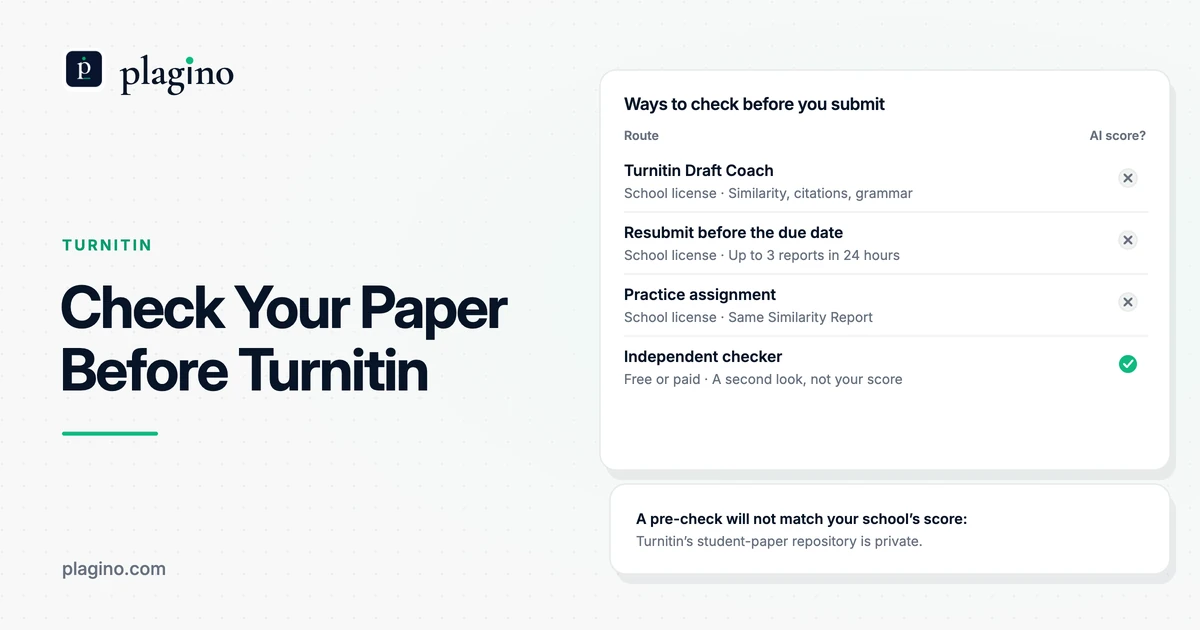
The same article says the tools are separate systems and that the 40% setting does not predict or reproduce a Turnitin result. Access differs as well. Turnitin does not sell individual licenses, so students only reach it through their school, while anyone can buy Originality.ai. If your goal is a pre-check before a Turnitin submission, read our guide on checking your paper before Turnitin and remember that no outside tool can show you your school's Turnitin score.
What does Originality.ai cost?
Originality.ai's paid plans start at $14.95 a month, and every check is paid for in credits, where 1 credit covers 100 words. The figures below come from the Originality.ai pricing page, checked on 18 October 2026. Prices are in US dollars and change often, so confirm them before you subscribe.
Is there a free Originality AI checker?
Yes, but it only does AI detection. The free Basic plan allows 3 scans a day of up to 2,000 words each. Plagiarism checking, readability and fact-checking need a paid plan. Plagino's free plan gives 3 scans a month, each covering both AI writing and plagiarism, with no card required.
How far do Originality.ai credits go?
On Pro, 2,000 credits cover about 200,000 words of AI-only checking a month, or about 100,000 words if you also run plagiarism checks. A 2,000-word essay costs 20 credits for an AI check and 40 for AI plus plagiarism. That suits bulk checking of articles; for a student checking a few drafts a term, the free tier or a per-scan plan is usually enough.
| Originality.ai | Plagino | |
|---|---|---|
| Free use | Basic: AI detection only, 3 scans a day, up to 2,000 words per scan | 3 scans a month, no card |
| Entry paid plan | Pro: $14.95/month, or $12.95/month billed annually ($155.40/year) | Pro: $19/month |
| Usage on that plan | 2,000 credits a month; unused credits expire at month end | 20 scans a day |
| Credit cost per check | 1 credit per 100 words for AI only; 2 credits per 100 words for AI plus plagiarism | Each scan covers AI and plagiarism |
| Higher plan | Enterprise: $179/month, or $136.58/month billed annually; 15,000 credits, API access, 365-day scan history | None |
| Scan history | 30 days on Pro, 365 days on Enterprise | Kept while your account is active; delete any scan to remove its file and report |
| Teams | Extra seats sold per plan | Team: custom pricing for departments and writing centres |
| Plagiarism check compares against | Public web content; LMS and institutional integrations add academic databases | Open-access academic literature via CORE |
| Other checks | Readability, grammar, fact-checking, full website scans | None |
| How you submit | Paste, .docx, .doc or PDF upload, URL, Chrome extension, Moodle plugin | .docx upload in the web app |
| Report | AI score with sentence highlights; shareable reports on Enterprise | PDF with sentence-level AI highlights and matched sources |
What does Originality.ai do with your text?
By default, Originality.ai may use your scans to improve its detector, but every user can opt out. Its privacy policy, last amended on 17 June 2026, says: "Unless you opt out, we may use your scan history and scan results to help train and improve our models."
Schools get stronger terms. Student data processed under an official institutional agreement is not used to train general-purpose AI models, and the policy ties its promise not to train on student data to the customer opting out of training. A student using a personal account is not covered by a school agreement, so switch the opt-out on if your draft is unpublished work you want to keep out of any training set.
Originality.ai vs Plagino: which should you use?
Pick by the job, not the brand. Originality.ai fits people checking web content at volume; Plagino fits students and teachers checking academic drafts, where a wrong flag carries real consequences. Plagino is our tool, so weigh this section with that in mind.
When is Originality.ai the better choice?
Originality.ai is the better choice when you check web content in bulk. It scans whole websites by URL, checks plagiarism against the public web, and adds fact-checking, readability and grammar in one plan. Its free Chrome extension can replay how a Google Doc was written, which gives an editor more context than a score alone. Plagino does none of this.
Price per word also favours it at volume. At $12.95 a month billed annually for 2,000 credits, Originality.ai is built for checking by word count, and AI Allowance lets a team set a tolerance that matches its policy. Schools on Moodle get a plugin; Plagino has no LMS integration.
When is Plagino the better choice?
Plagino is the better choice when a false accusation is the costliest mistake. In our benchmark it wrongly flagged 0.8% of human-written documents against Originality.ai's 4.1%, a gap outside the margin of error. It also caught slightly more AI writing, 97.4% against 95.6%, though that difference is within the margin.
You upload a .docx file and get a PDF report with sentence-level AI-writing highlights and matched academic sources from the plagiarism checker, which you can keep and discuss with a tutor. The free plan gives 3 scans a month with no card, and Pro costs $19 a month for 20 scans a day. Students can start from the AI checker for students page; teachers from AI detector for teachers.
| Your situation | Better fit | Why |
|---|---|---|
| Editor checking freelance blog posts | Originality.ai | Web plagiarism, URL and full-site scans, fact-checking |
| Agency auditing a whole website | Originality.ai | Site scanner and Enterprise API |
| Team with a written AI-use policy | Originality.ai | AI Allowance thresholds match a policy percentage |
| Student checking an essay before submitting | Plagino | 0.8% false flags in our test, against 4.1% |
| Teacher who wants evidence to discuss with a student | Plagino | PDF report with sentence-level highlights and matched sources |
| Checking against academic papers rather than web pages | Plagino | Plagiarism matching against open-access research via CORE |
| Need to match a Turnitin score | Neither | Only your school's Turnitin account shows that |
What are the limits of this comparison?
The benchmark has limits that apply to Plagino's results as much as to Originality.ai's. Knowing them tells you how far to trust any single figure on this page.
What the benchmark does not cover
The corpus was English only, and the AI documents came from GPT-4o, Claude and Gemini, so results on other languages or newer models may differ. We scored at document level, so one flagged sentence in a human essay counted as a false positive. We used each tool's default settings in March 2026; AI Allowance, which can raise the threshold to cut false positives, did not exist yet.
Each rate rests on 500 documents. That separates large gaps, such as the false-positive difference between Originality.ai and Plagino, but not small ones, such as their detection rates. The confidence intervals in the first table show which is which.
Who gets falsely flagged
A single rate also hides who bears the errors. A 2023 Stanford study found that several AI detectors misclassified more than half of TOEFL essays by non-native English writers as AI-generated. Turnitin reports that false positives are more common in documents with less than 20% AI writing. Our guide to AI detector false positives covers what to do with a borderline result, and if you have already been flagged, see falsely accused of using AI.
For other head-to-head results, see Plagino vs Copyleaks, Plagino vs GPTZero, Plagino vs ZeroGPT and the full best AI detectors ranking.
Frequently asked questions
Is Originality AI accurate?
It catches AI writing well but produces more false positives than most rivals. In Plagino's March 2026 benchmark of 1,000 documents, Originality.ai caught 95.6% of AI-written documents and wrongly flagged 4.1% of human-written ones. Originality.ai's own benchmark reports 99.4% accuracy for AI Allowance at the default 15% threshold.
Is Originality AI free?
There is a free Basic plan for AI detection only, with 3 scans a day and up to 2,000 words per scan. Plagiarism checking, readability and fact-checking need a paid plan, which starts at $14.95 a month, or $12.95 a month billed annually.
Is Originality AI better than Turnitin?
Not in Plagino's benchmark. Turnitin caught 98.2% of AI-written documents against 95.6% for Originality.ai, and wrongly flagged 1.4% of human documents against 4.1%. Turnitin is only sold to institutions, though, while anyone can buy Originality.ai.
Can Originality AI tell me my Turnitin score?
No. Originality.ai says its tools are separate from Turnitin and that even its closest setting, 40% AI Allowance, agreed with Turnitin on 69.7% of 300 essays. Only your school's Turnitin account shows your Turnitin result.
What is a good score on Originality AI?
A "Likely Original" verdict with high confidence is the result most writers want. The percentage is the model's confidence, not the share of your text written by AI, so "60% confident Original" is a weak human verdict, not 40% AI content. The meaning also shifts with the AI Allowance setting you choose.
Does Originality AI use my text to train its models?
It may, unless you opt out. Originality.ai's privacy policy says scan history and results may be used to train and improve its models, and that all users can opt out. Student data processed under an official school agreement is not used to train general-purpose AI models.
Who is Originality AI designed for?
Mainly publishers, agencies and content teams. It scans websites, checks plagiarism against the public web and adds fact-checking and readability. It also offers a Moodle plugin and enterprise plans for schools, but its feature set is built around web content.
Does Originality AI check for plagiarism too?
Yes, on paid plans. An AI-plus-plagiarism check costs 2 credits per 100 words instead of 1. Its web app compares text with public web content, while Plagino's plagiarism check compares it with open-access academic research.
How many words does Originality AI check per credit?
One credit covers 100 words for an AI-only check. The Pro plan's 2,000 monthly credits therefore cover about 200,000 words of AI checking, and unused credits expire at the end of each month.
Can Originality AI detect text in other languages?
Yes. Originality.ai runs a separate Multilingual model that covers 30 languages. Plagino's benchmark tested English only, so we have no independent figures for its accuracy in other languages.
What should I do if Originality AI flags my work as AI?
Treat the flag as a reason to review, not as proof. Keep your drafts, notes and document version history, which are stronger evidence of authorship than any detector score. Our guide for students falsely accused of using AI explains how to respond through your institution's process.
Is Originality AI legit?
Yes. It is an established commercial product with public pricing, a documented model history and a published privacy policy. Being legitimate does not make any single scan correct, which is why its own help pages say results should be weighed alongside other evidence of authorship.